


About this print
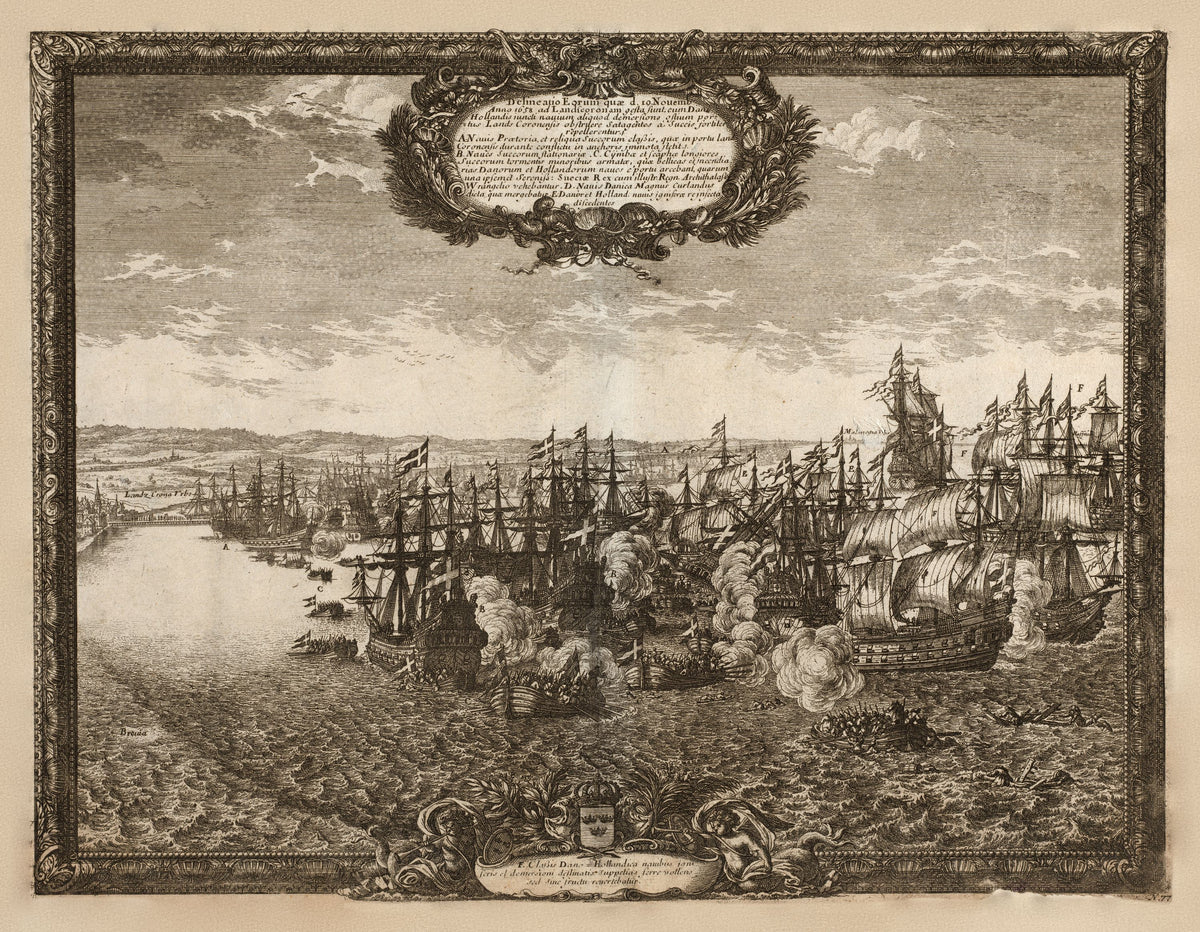
Delineatio eorum quae d. 10 Novemb. anno 1658 ad Landscoronam gesta sunt — Erik Dahlbergh, engraved for Pufendorf's history of Charles X Gustav, 1696.
A plan of the naval action off Landskrona on 10 November 1658, when the Dutch fleet broke the Swedish blockade of Copenhagen.
In 1658 Charles X Gustav of Sweden renewed his war on Denmark, months after the Treaty of Roskilde, and laid siege to Copenhagen. On 8 November (29 October in the old calendar) a Dutch fleet under Jacob van Wassenaer Obdam forced its way through and broke the blockade. The Dutch admiral Witte de With was mortally wounded when Swedes boarded his stranded ship. The Swedes later abandoned the siege.
Erik Dahlbergh served Charles X Gustav as an engineer in these wars and directed engineers at the siege of Copenhagen. He later helped Samuel Pufendorf with his history of the king's reign, and this plan was published in it at Nuremberg in 1696, nearly forty years after the battle.
Original held by the Norman B. Leventhal Map & Education Center, Boston Public Library. Restored by Limner from the library's scan; nothing redrawn.
Look closer
-

Boats armed with guns
The King of Sweden, Charles X Gustav, went into the fight in a small boat. Letter C in the key marks the gun-armed boats and skiffs, in one of which, it says, the king was carried with Wrangel.
-

The three crowns
Sweden's three crowns were once a cause of war. Denmark also used them, as a relic of the Kalmar Union that had joined the Scandinavian kingdoms, and the quarrel helped start the Northern Seven Years' War in 1563. In 1658 the two kingdoms were at war again, and Sweden's crowned shield sits beneath the key.