




About this print
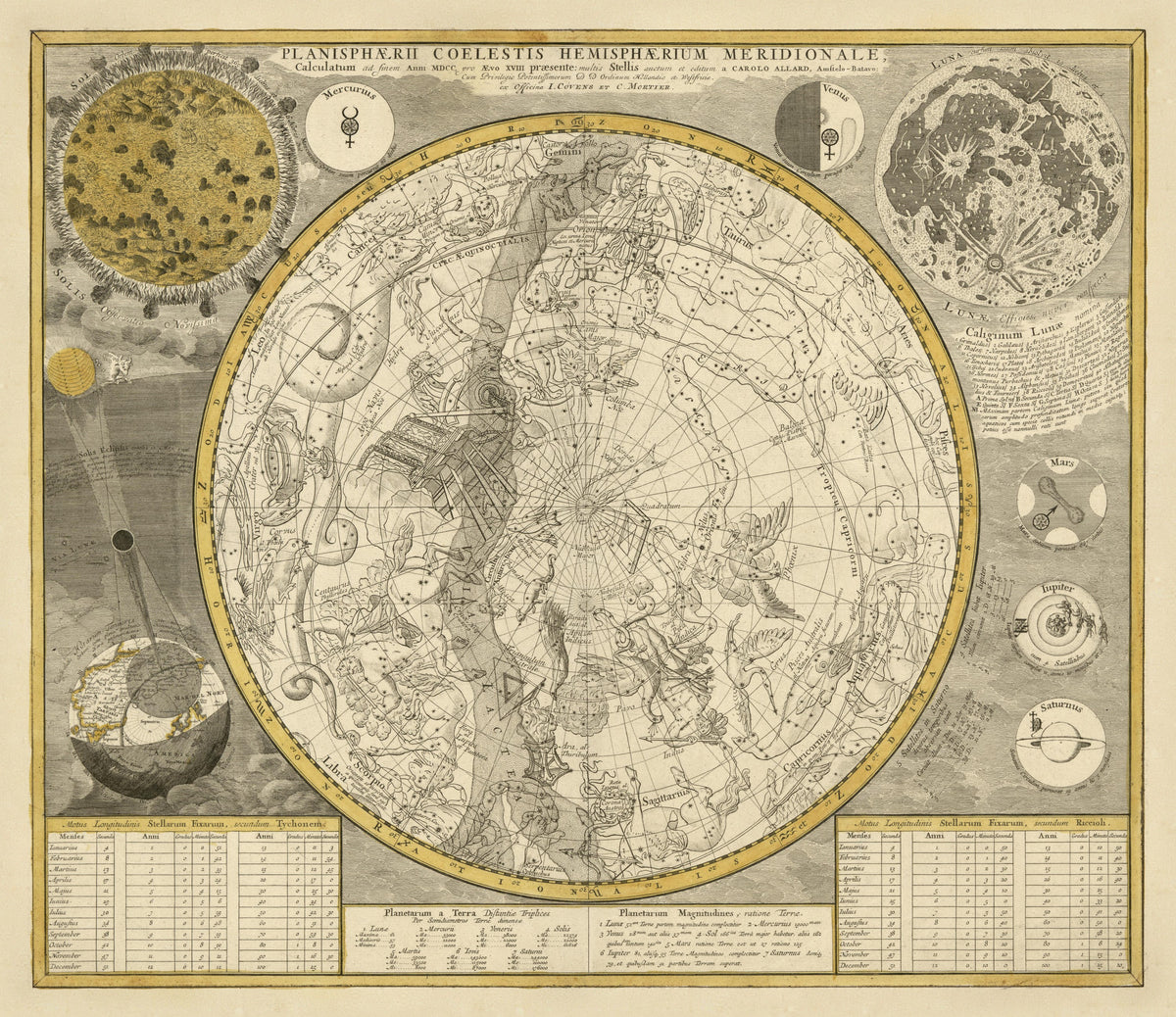
Planisphaerii Coelestis Hemisphaerium Meridionale, Carel Allard; published by I. Cóvens and C. Mortier, Amsterdam, about 1700.
The southern half of the heavens, with the constellations and the signs of the zodiac drawn as figures, and small pictures of the sun, the moon, an eclipse and the five planets then known.
Its title says it was calculated for the end of the year 1700. The far southern stars were charted late. On the first Dutch voyage to the East Indies, in 1595 to 1597, Pieter Keyser and Frederick de Houtman each recorded the positions of stars never seen from Europe. Twelve new constellations were made from them, among them Phoenix, Dorado, Chamaeleon and Indus; they first appeared on a globe by Petrus Plancius in 1598, and in Johann Bayer's star atlas of 1603.
Carel Allard (1648 to about 1709) was an Amsterdam engraver, publisher and art dealer, the son of the mapseller Hugo Allard, whose business he inherited. In 1706 he passed his copperplates to his son Abraham, and he later went bankrupt. This chart was also issued in Cóvens and Mortier's Atlas nouveau.
Original held by the Library of Congress, Geography and Map Division. Restored by Limner from the library's scan; nothing redrawn.
Look closer
-

Jupiter's bodyguard
Jupiter's moons are drawn as his bodyguard. Lettered "cum 4 Satellitibus", with four satellites, they march round the enthroned god as armed soldiers, each carrying a star. The Latin satelles meant an attendant or bodyguard, and Kepler used it for these moons in the 1610s, soon after Galileo first saw them in January 1610.
-

The eclipse of 1706
The chart records an eclipse from six years after the year its title is calculated for. The panel is headed "Memoranda Solis Eclipsis totalis 12 Maji 1706", and the globe below shows the Moon's shadow over Europe. That eclipse was total in a band from Spain and France across Switzerland to the Baltic, and was the first eclipse to have predictive maps.
-

Noah's Ark among the stars
The ship carries two names: "Argo Navis al. Arca Noë", the Argo, otherwise Noah's Ark. Julius Schiller's star atlas of 1627 had turned the Argonauts' ship into the Ark. The constellation was later split into today's Carina, Puppis and Vela; it is the only one of Ptolemy's 48 no longer recognised as a single constellation.