


About this print
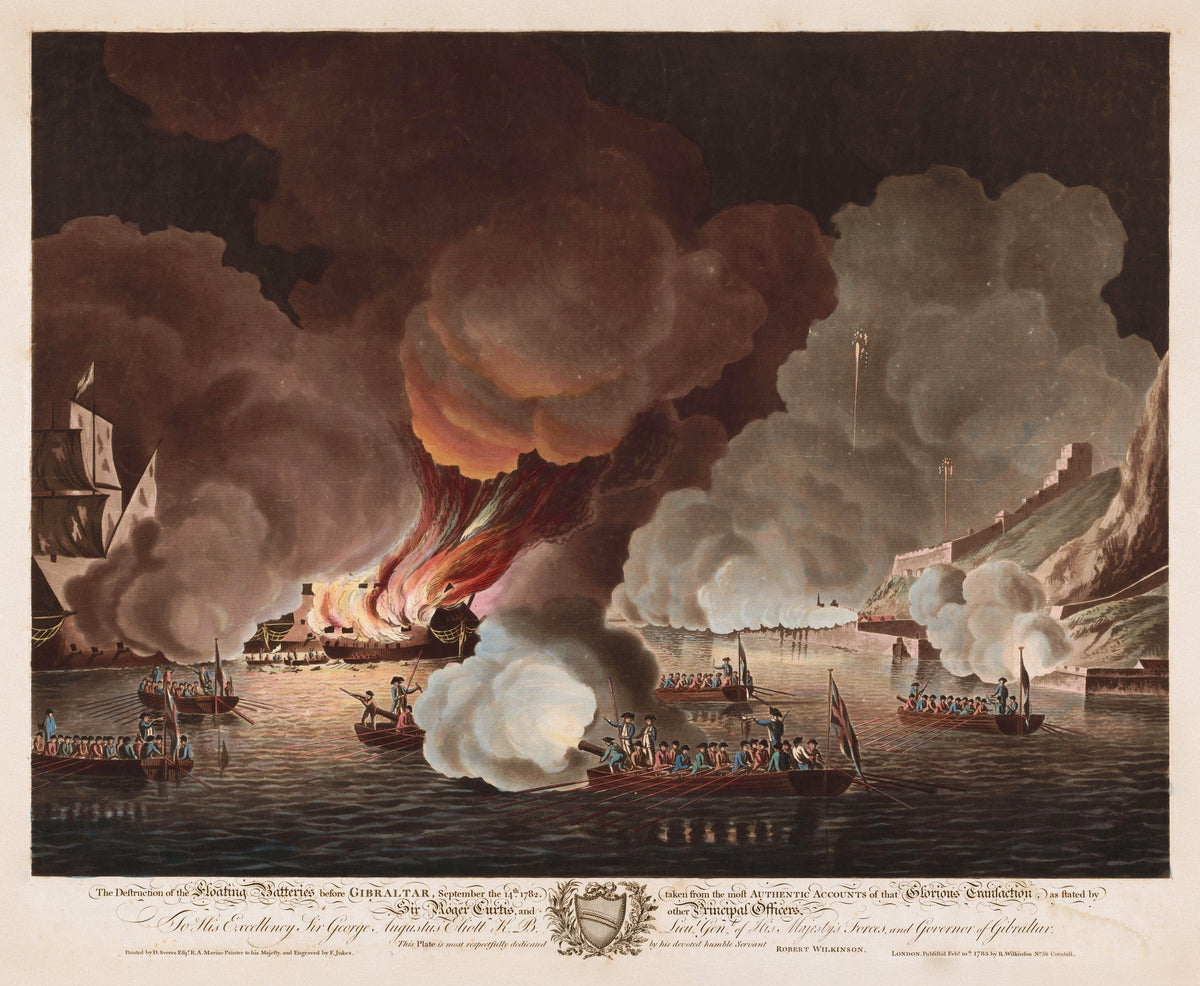
The Destruction of the Floating Batteries before Gibraltar, September the 14th 1782 — Francis Jukes after Dominic Serres, published by Robert Wilkinson, London, 1783.
The night the Franco-Spanish floating batteries burned beneath the Rock: the climax of the Great Siege, hand-coloured in aquatint, with the flames painted in by hand.
Spain and France laid siege to Gibraltar in the summer of 1779, during the American War of Independence. On 13 September 1782 they sent in ten floating batteries designed by the French engineer d'Arçon. General Eliott's garrison answered with red-hot shot, and by midnight the batteries were burning. The attackers lost 1,473 men; the British, 15 killed and 68 wounded. Hostilities ended in February 1783, with peace talks under way, after three years and seven months.
Dominic Serres, born in France and brought to England as a prisoner of war in the 1750s, was a founder member of the Royal Academy and, from 1780, Marine Painter to George III. Francis Jukes's aquatint after his picture was published in London on 10 February 1783, as the siege drew to a close.
Original held by the Rijksmuseum, Amsterdam. Restored by Limner from the museum's scan; nothing redrawn.
Look closer
-

Curtis's gunboats
The victors rowing in to save the beaten: on 13 September 1782 Captain Roger Curtis's gunboats pulled Spanish sailors from the burning batteries as they blew up.
-

General Eliott's arms
The shield belongs to the man the print is dedicated to: General George Augustus Eliott, governor of Gibraltar through the Great Siege. These are the arms of his family, the Eliotts of Stobs, with their motto "Soyez sage", "be wise". When he was made Lord Heathfield in 1787, his arms gained the fortress of Gibraltar and a key.