


About this print
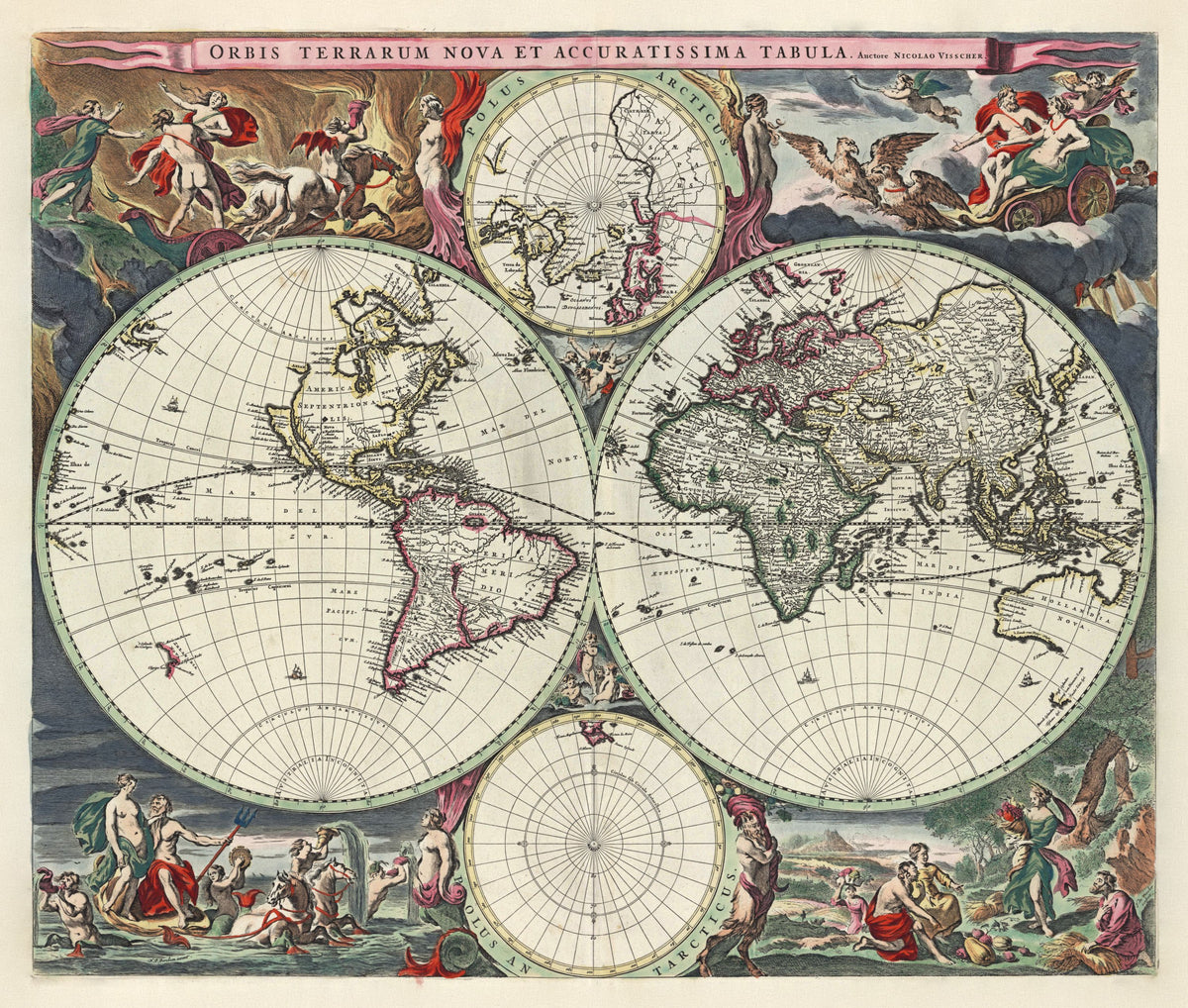
Orbis Terrarum Nova et Accuratissima Tabula — Nicolaes Visscher, with borders by Nicolaes Berchem, Amsterdam, first issued 1658.
Visscher's celebrated world map: the seasons and the classical gods around two richly ornamented spheres.
Nicolaes Visscher (1618–1679) was the son of Claes Jansz Visscher, founder of the family map business on Amsterdam's Kalverstraat, and his own son Nicolaes II carried it on. This plate was engraved by Jan de Visscher and records Abel Tasman's voyages of 1642–43 and 1644, which showed that Australia was not part of any southern continent; the land is named Hollandia Nova.
The map first appeared in Jan Janssonius's Novus Atlas, published in Amsterdam in 1658. The National Library of Australia, which holds a copy, showed it in its 2013–14 exhibition Mapping Our World: Terra Incognita to Australia. It is an early example of the heavily decorated Dutch world map.
Original held by the University of Michigan. Restored by Limner from the library's scan; nothing redrawn.
Look closer
-

The four elements
Each corner is a myth standing for an element: Zeus in his eagle-drawn chariot is air, Persephone carried to the underworld is fire, Poseidon is water and Demeter's harvest is earth. In 1658 the world was still made of four ingredients.
-

Van Diemen's Land
Tasmania 16 years after Tasman sighted it, under the name he gave it in 1642: "Antonij van Diemens Landt", after the governor-general who sent him. It officially became Tasmania in 1856.
-

California and Nova Albion
California as an island, topped by "Nova Albion", the name Francis Drake gave the coast when he landed and claimed it for Elizabeth I in 1579.