


About this print
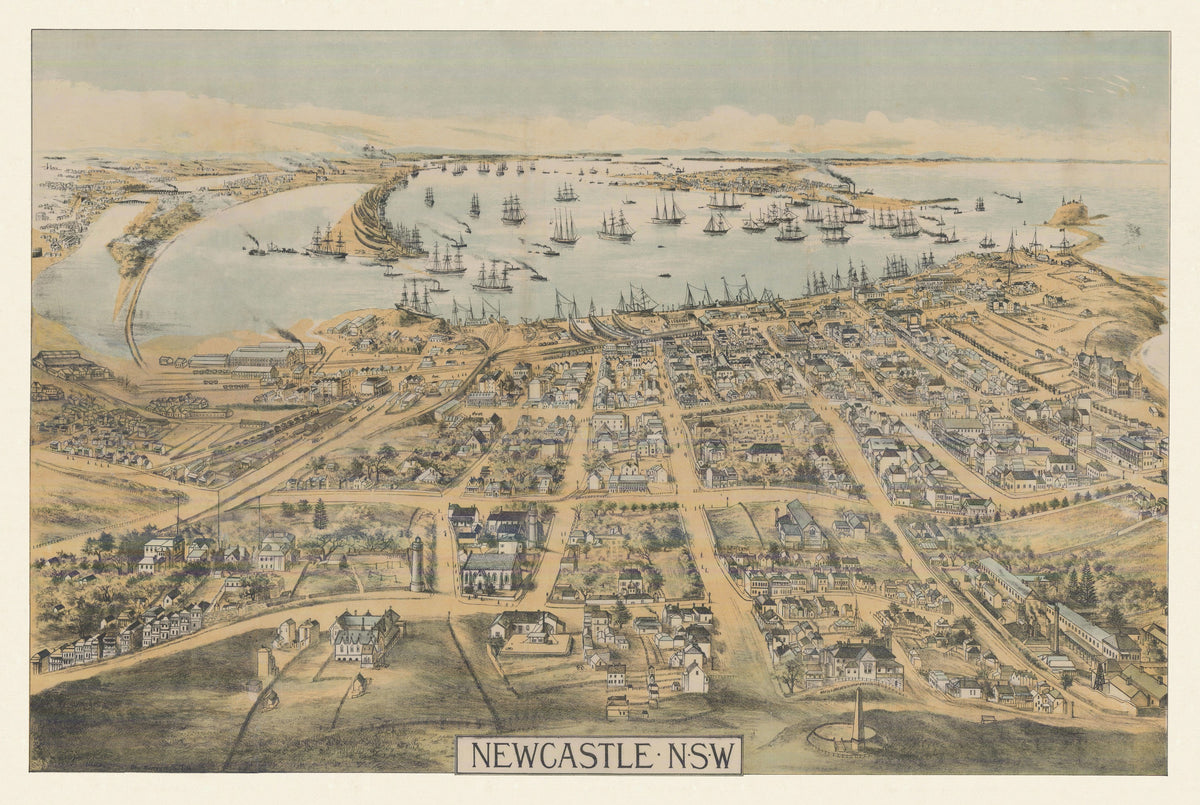
Newcastle, N.S.W. — Alfred Scott Broad; printed by Geo. Murray & Co., Sydney, 1889.
A colour lithograph of Newcastle drawn from above The Hill, looking over the town to a harbour crowded with sailing ships.
It was issued as a supplement to The Illustrated Sydney News on 27 June 1889. Newcastle was then one of the great coal ports of the southern hemisphere, and the artist has filled the Hunter River with square-riggers at anchor, lined them along the wharves and sent steam tugs between them. Nobbys Head closes the view at the top right, joined to the town by its breakwater.
In the foreground the streets of The Hill climb towards the viewer, with churches, terraces and villas drawn building by building.
Alfred Scott Broad (1854–1929) drew for the illustrated papers of Adelaide and Sydney.
Original held by Special Collections, University of Newcastle (Australia). Restored by Limner from the library's scan; nothing redrawn.
Look closer
-

A harbour full of masts
Count the ships: dozens of barques and full-rigged ships lie at anchor waiting for coal, with more tied up along the foreshore.
-

The Obelisk
At the bottom edge, right of the title, a white obelisk stands on its round base at the top of The Hill, a landmark for ships that is still there.
-

Nobbys
Top right, the headland and its lighthouse sit at the end of the long breakwater that convicts began building in the 1810s.