


About this print
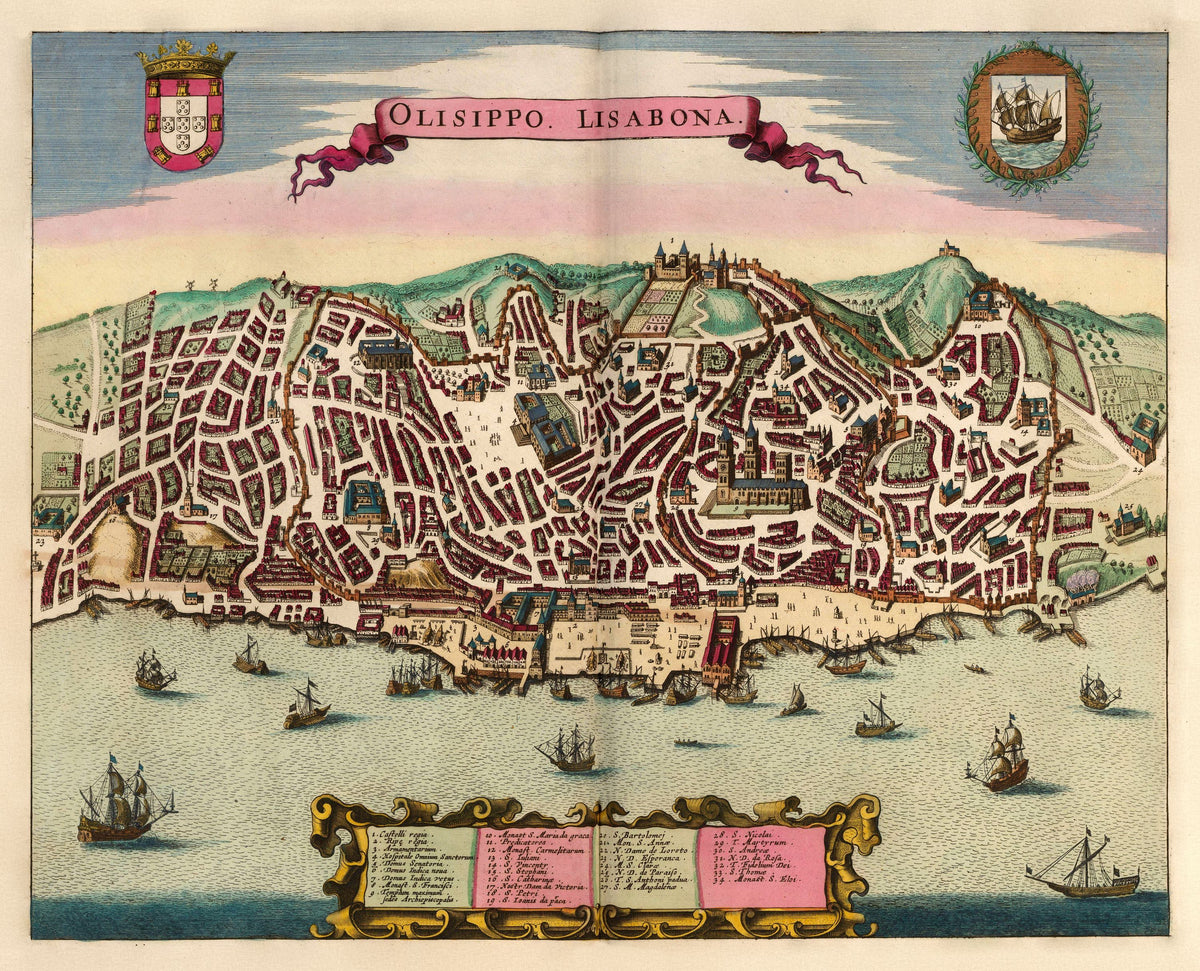
Olisippo Lisabona — Johannes Janssonius, Amsterdam, 1657.
Lisbon seen from the Tagus, with ships and small boats crowding the water. A table at the foot keys 34 numbered sites to the view, beginning with "Castelli regia", the royal castle on the hilltop. Hand-coloured by Anna Beeck of The Hague.
When this view was published, Portugal had been independent again for only sixteen years. On 1 December 1640 conspirators in Lisbon ended sixty years of union with Spain and acclaimed the Duke of Braganza as King John IV, who died in November 1656; Spain did not recognise the Braganza dynasty until 1668. The riverside Ribeira Palace, the royal residence since 1502, stood until the earthquake, tsunami and fire of 1 November 1755.
Johannes Janssonius of Amsterdam issued the view in 1657 in his Theatrum of the notable cities of Spain and other cities to the east and south. The colour came later: Anna Beeck, born in The Hague in 1657, went on to run a map and print business, issuing city plans and battle maps from 1697.
Original held by the Rijksmuseum, Amsterdam. Restored by Limner from the museum's scan; nothing redrawn.
Look closer
-

The arms of Portugal
The crown of Portugal, newly its own again: in 1657 the country had been free of Spanish kings for only sixteen years. Five small shields, each set with five silver coins, sit inside a red border of gold castles added by Afonso III in the 1200s. By tradition the shields stand for five Moorish kings defeated at Ourique.
-

St Vincent's ship
Lisbon's own arms are a ship. In 1173 King Afonso Henriques had the body of St Vincent, the city's patron, carried by sea from Cape St Vincent to Lisbon Cathedral, and legend says ravens guarded it all the way. The city's arms still show a raven at each end of the ship; this engraver drew the ship alone.